

What should you actually do during Chandra Grahan according to Sai Baba. This article explains the grahan without fear, superstition, or ritual pressure, and shows how Baba encouraged understanding, inner stillness, and balanced faith instead of anxiety-driven practices.
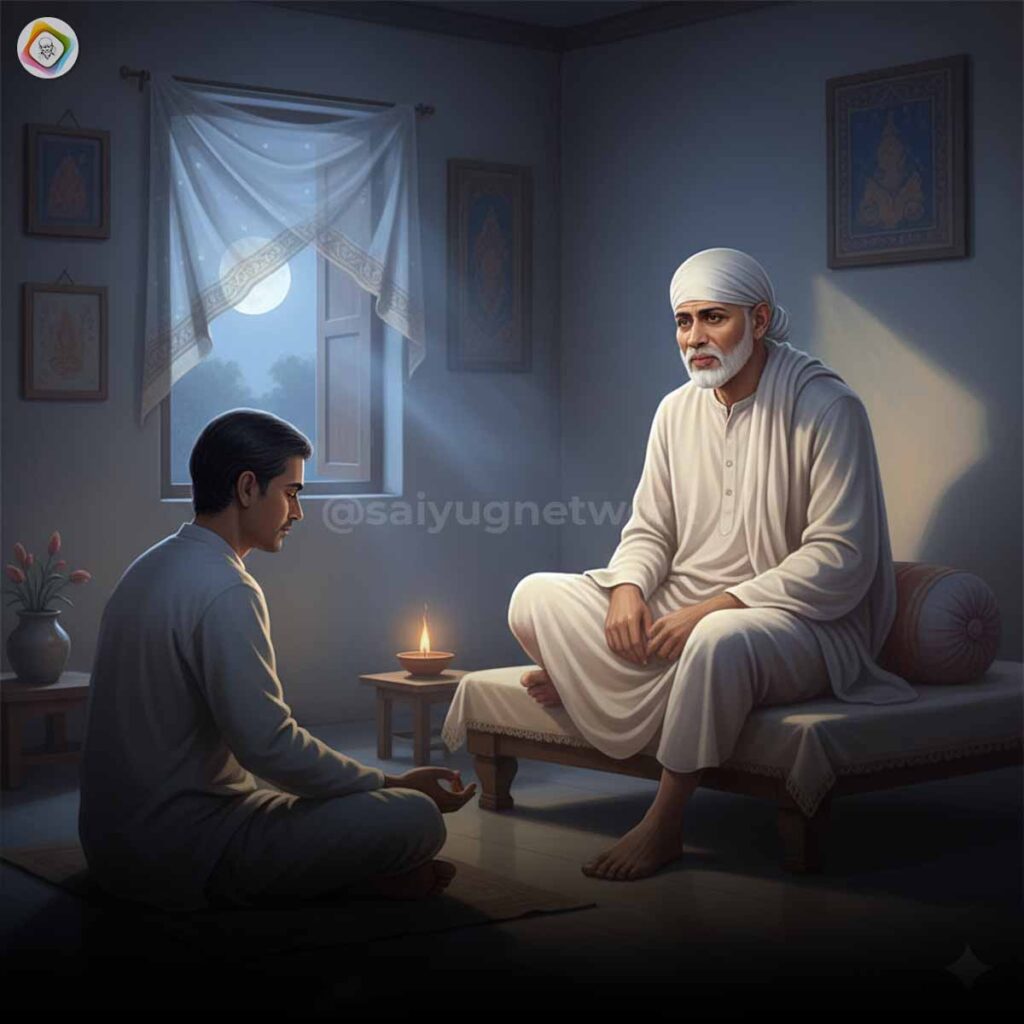
Every Chandra Grahan (lunar eclipse) brings with it a familiar pattern. Questions begin to circulate quietly among devotees. Some feel anxious. Some feel unsure. Some feel guilty even before the grahan begins.
- Should food be avoided.
- Should prayers stop.
- Should temples remain closed.
- Is something inauspicious happening in the universe.
Over time, these questions have moved further away from curiosity and closer to fear.
This article is not written to dismiss tradition, nor to challenge faith. It is written to restore balance. Because Sai Baba never encouraged fear-based devotion. He encouraged understanding rooted in Shraddha.
To understand grahan properly, we must first separate fact from fear, and discipline from superstition.
What Chandra Grahan (Lunar Eclipse) Actually Is
At its core, Chandra Grahan (lunar eclipse) is a purely astronomical event.
It occurs when the Sun, Earth, and Moon align in a straight line, with the Earth positioned between the Sun and the Moon. During this alignment, the Earth’s shadow falls on the Moon, causing the Moon to appear partially or fully obscured for a period of time.
This phenomenon follows precise celestial laws. Its timing can be calculated years in advance.
Its duration is fixed and predictable.
There is nothing sudden, chaotic, or abnormal about it.
Chandra Grahan (lunar eclipse) does not introduce any new energy into the universe. It does not disturb cosmic balance. It does not alter divine order.
It is simply the movement of celestial bodies following the rhythm they have always followed.
When something is natural, predictable, and recurring, it does not require fear. It requires understanding.
The Idea of “Ashubh” and Where Fear Entered
One of the strongest beliefs surrounding Chandra Grahan (lunar eclipse) is that it is “ashubh” or inauspicious.
This belief did not arise from astronomy, nor from spiritual texts that emphasise inner purity.
It emerged gradually through misinterpretation, exaggeration, and loss of context.
Over generations, instructions meant for discipline were converted into warnings. Guidelines meant for safety were turned into fear-based rules.
As context disappeared, fear took its place.
When people no longer remembered why something was done, they assumed it was done to avoid danger.
But danger was never the foundation.
Understanding Traditional Practices With Context
It is important to approach traditional beliefs with respect, not rejection.
In earlier times, life conditions were very different.
- There was no electricity.
- There was no refrigeration.
- Night-time movement was unsafe.
- Medical facilities were limited or unavailable.
- Food hygiene required extra caution.
- Pregnant women needed physical protection.
- Darkness increased vulnerability.
During such times, grahan-related disciplines made practical sense.
- Avoid cooking at night.
- Avoid unnecessary movement.
- Rest the body.
- Reduce activity.
These were not spiritual punishments. They were protective routines.
Over time, as circumstances changed, the practices remained, but their reasons were forgotten.
When reason disappears, fear fills the gap.
Why Blind Imitation Is Not Shraddha
Shraddha has never meant blind following.
Shraddha means trust supported by awareness.
Sai Baba repeatedly guided devotees to use their buddhi along with their faith. He never supported blind imitation. He never promoted fear-driven behaviour.
A practice without understanding becomes mechanical. And mechanical devotion loses its soul.
In today’s world, we have access to hygiene, safety, medical knowledge, and secure living conditions. Applying old rules without considering present reality does not strengthen devotion. It weakens clarity.
Sai Baba valued sincerity, not rigid adherence.
Sai Baba’s Approach Toward Grahan and Fear
Sai Baba never spoke of grahan as a fearful event. He never instructed devotees to stop worship during such times. He never suggested that God becomes unavailable during celestial movements.
In Baba’s worldview, divinity was constant.
God did not enter or exit based on planetary positions. Bhakti did not depend on timing. Grace was not restricted by shadow or light.
Baba’s emphasis was always inward.
- Keep the mind steady.
- Keep actions honest.
- Keep faith simple.
Fear was never part of His teaching.
“Shraddha Rakho, Par Buddhi Ko Band Mat Karo”
This one teaching holds deep relevance when discussing grahan. Faith without understanding easily turns into anxiety. Understanding without faith becomes dry and detached.
Baba never separated the two.
He wanted devotees to trust, but not panic.
To believe, but not surrender their intelligence.
Chandra Grahan (lunar eclipse) is not a test of devotion.
It is not a punishment.
It is not a warning from the divine.
It is a natural pause in light.
What Grahan Time Actually Represents Spiritually
Beyond astronomy, grahan holds a symbolic meaning.
- During grahan, nature itself slows down.
- The environment becomes quieter.
- The body feels slightly withdrawn.
- The mind turns inward.
This is not harm.
This is stillness.
Spiritually, grahan represents a moment of pause.
A reminder that not every moment requires action. Some moments ask for rest. Some moments ask for observation. This is why ancient traditions associated grahan with restraint, not fear.
How to Approach Chandra Grahan (lunar eclipse) in Today’s Life
In today’s context, the most balanced approach is a practical one. During grahan time, it is advisable to reduce unnecessary activity.
- Avoid overworking the body.
- Avoid emotional arguments.
- Avoid making important decisions.
- Avoid mental overload.
Not because something bad will happen, but because transitions naturally reduce clarity.
Rest during transitions is wisdom.
If You Choose to Do Something During Grahan
If you feel inclined to engage inwardly, keep it simple.
- Sit quietly.
- Focus on your breath.
- Remember Baba’s name softly.
- Or simply remain silent.
- There is no compulsion to perform rituals.
- There is no requirement to chant for hours.
- There is no pressure to prove devotion.
Silence itself is a form of alignment.
Grahan as Energy Correction, Not Punishment
Many spiritual traditions describe grahan as a time of internal recalibration.
This does not mean something is wrong. It means the system is adjusting.
Just as sleep recalibrates the body, stillness recalibrates the mind.
Grahan invites slowing down.
Nothing more.
Food and Eating During Chandra Grahan (lunar eclipse)
Food-related fear is one of the most common anxieties.
From a practical perspective, the approach should be simple.
- If you feel hungry, eat light and simple food.
- There is no spiritual benefit in forced starvation.
- There is no merit in dehydration.
Water is safe.
Basic food is safe.
Discipline is about balance, not suffering.
Removing Fear of Pregnancy and Grahan
Pregnant women are often subjected to the highest level of fear during grahan.
This needs correction.
Pregnancy requires calm, nourishment, and emotional stability. Fear harms more than any celestial event.
A pregnant woman should rest if tired, eat when hungry, and remain comfortable.
These actions support health. Fear does not.
Temples, Worship, and the Question of Closure
Temple closures during grahan are often misunderstood.
When temples close, it is usually due to traditional protocol or administrative reasons, not because God is absent.
Sai Baba does not disappear during grahan.
Divinity does not shut down.
Your connection with Baba does not depend on temple doors.
A calm mind is the real place of worship.
Releasing Guilt From Devotion
Many devotees experience guilt if they do not follow grahan rituals.
This guilt is unnecessary.
Baba never demanded performance. He looked at intent.
Peace in the heart is worship.
Clarity in the mind is prayer.
Ritual without peace is empty.
Peace without ritual is complete.
After the Grahan Passes
Once the grahan ends, return to your normal routine.
- Resume work.
- Eat normally.
- Continue daily life.
Extra baths or rituals are optional, not compulsory.
If the mind feels light, purification has already happened.
What Chandra Grahan (lunar eclipse) Teaches Us
Chandra Grahan (lunar eclipse) does not bring darkness into life. It teaches us to pause.
- It reminds us that slowing down is not weakness.
- That silence is not emptiness.
- That rest is not neglect.
This lesson applies beyond astronomy.
Sai Baba’s Path Is Fear-Free
Sai Baba never ruled through fear.
He guided through reassurance.
Devotion should make life lighter. Not heavier.
If faith increases anxiety, something is misplaced. Understanding restores balance.
Chandra Grahan (lunar eclipse) is not an enemy of devotion.
It is not an omen.
It is not a threat.
It is a natural rhythm of the cosmos.
When understood correctly, it brings calm, not fear.
Grahan does not bring darkness.
Grahan teaches us to pause and observe.
And always remember.
Dar se bhari bhakti nahi hoti.
Samajh se bhari shraddha hoti hai.
Om Sai Ram.
© Shirdi Sai Baba Life Teachings and Stories – Member of SaiYugNetwork.com