

Hidden Yoga in Sai Baba Naivedyam uncovers a deeper layer of devotion often missed during daily Aarti. What appears as a simple food offering becomes a subtle inner act of surrender. Through the Pancha Pranas, the devotee offers breath, action, speech, and identity itself. This article guides you to see Naivedyam not as ritual, but as living yoga that loosens ego and aligns the seeker with Sai Baba’s state of silent awareness.
Naivedyam to Samadhi: The Hidden Yoga Inside Shirdi Sai Baba’s Aarti
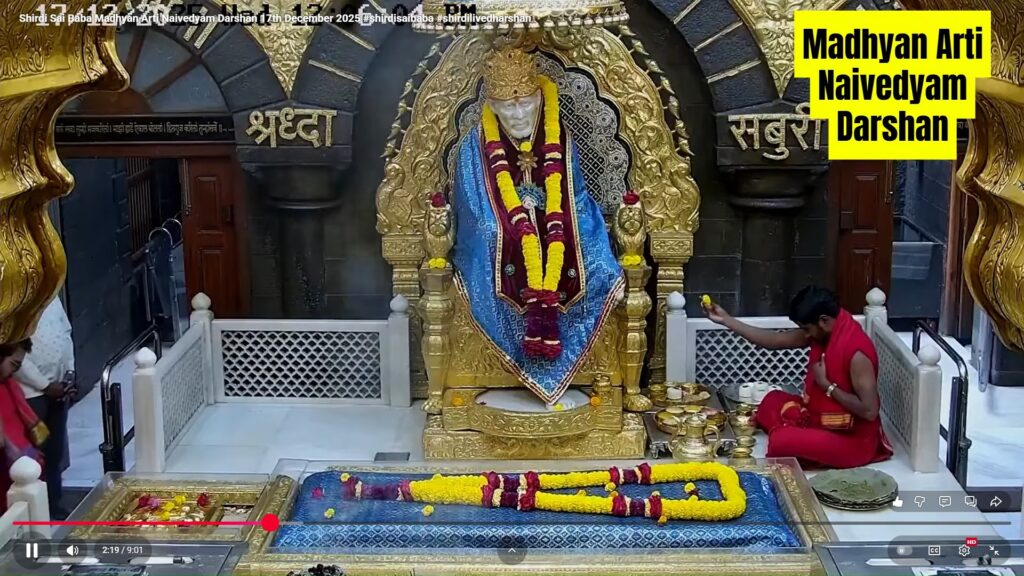
Before you start reading the post, we request you to first watch this video of offering Naivedyam to our Sai Baba during Madhyan Arti in Samadhi Mandir, Shirdi.
“Om Pranaya Svaha… Om Apanaya Svaha…”
Every Sai devotee has heard these sacred words during the Naivedyam Aarti at Shirdi Sai Baba’s Samadhi Mandir.
We hear them… we fold our hands… but rarely do we pause to ask:
What exactly are we offering to Sai?
This post is an invitation to look a little deeper, with devotion, Ayurveda, yoga wisdom, and modern understanding, all flowing together like one river.
What is Naivedyam – The outer meaning
Naivedyam is a Sanskrit word that means offering.
In daily worship, it refers to the food offered to the deity before we eat.
First, the food is placed before God.
Mantras are chanted.
The offering is accepted by the Divine.
After this ritual, the food is no longer ordinary food,
it becomes Prasad, blessed nourishment.
Most of us understand this much:
“The food is purified and does good to us.”
This understanding is true, but incomplete.
Ayurveda says: Food becomes YOU
Ayurveda explains that the body is built and sustained by food, but in a very intelligent way.
The body has three layers:
- Functional energies (Doshas)
- Vata – movement
- Pitta – transformation
- Kapha – stability
- Structural tissues (Dhatus) – These tissues are constantly formed, broken down, and rebuilt, just like a house that is under continuous repair. From food arise:
- Rasa (fluids)
- Rakta (blood)
- Mamsa (muscle)
- Meda (fat)
- Asthi (bone)
- Majja (marrow)
- Shukra (reproductive tissue)
- Waste products (Malas)
- Stool
- Urine
- Sweat
Their proper elimination keeps us healthy.
When digestion is good, tissues are healthy.
When tissues are healthy, Ojas is formed, the subtle essence of immunity, vitality, and mental clarity.
Modern science agrees:
Food influences hormones, immunity, brain chemistry, emotions, and behavior.
What we eat becomes not just our body, but also our mind and identity.
Enter the Pancha Pranas – The real stars of Naivedyam
The Naivedyam shloka does not mention food directly.
Instead, it mentions Prana.
Why?
Because Prana is what digests food… and life itself.
The Five Pranas:
- Prana Vayu (Head & chest)
- Brings in breath, sensations, perceptions
- Allows us to receive the world
- Samana Vayu (Navel / gut)
- Digests food and experiences
- Decides what to absorb and what to ignore
- Vyana Vayu (All over the body)
- Circulates energy, blood, nerve signals
- Converts intention into action
- Udana Vayu (Throat & head)
- Governs speech, memory, self-expression
- Helps us say: “I did this”
- Apana Vayu (Below the navel)
- Eliminates waste
- Grounds us, completes experiences
Together, these five currents run every action, thought, emotion, and reaction.
How the Pranas secretly create the “I”
Here is the most important insight, told in very simple terms.
Every experience follows this pattern:
Something is seen or heard
Prana receives it
The mind decides if it is important
Samana filters and judges
The body responds
Vyana moves into action
The event is named and remembered
Udana says: “I did this”
Satisfaction or discomfort follows
Apana completes the cycle
The brain, especially the prefrontal cortex, records this loop again and again and slowly builds a story:
“I am the doer.”
“I am clever.”
“I am weak.”
“I am successful.”
This story is called Ahamkar, the false “I”.
As long as the Pranas are running automatically,
The ego-story keeps playing.
Story of How the Pancha Pranas and the Prefrontal Cortex Build Ahamkar
In the warm darkness of the womb, a tiny spark of life begins. From a single cell, the body slowly forms. At birth, with the first breath, Prana opens the world to the newborn.
Every cry, every smell, every touch is received through Prana. At the same time, Samana, working quietly in the child’s little belly and heart, begins to decide what matters most. The mother’s voice, the warmth of her touch, the feeling of safety. These impressions are gently chosen and absorbed.
As the baby starts to move, reaching out with tiny hands and kicking little feet, Vyana spreads these sensations through the body. The child slowly learns a simple truth. When “I” move, something happens. The world responds.
When the child laughs and someone smiles back or offers praise, Udana connects words to the feeling. “You did that.” “You are good.” “You are loved.” These moments begin forming the first lines of an inner story.
As the day ends, Apana brings rest. Hunger is satisfied, the body relaxes, sleep comes. The child learns that actions lead to comfort and relief. The experience completes itself, and the cycle becomes stronger.
Deep inside the growing brain, the prefrontal cortex quietly observes these repeated patterns. Over time, it begins to weave them into a steady inner voice. That voice says, “I.” This is how Ahamkar grows stronger, the sense of being a doer.
With every success, every failure, every label given by parents, teachers, or society, the inner narrator adds new pages to its story. “I am brave.” “I am weak.” “I am clever.” “I am not good enough.” Slowly, habits turn into beliefs.
Actions born from this sense of “I” create effects in the world. Those effects return as praise, rejection, pleasure, or pain. These experiences shape future choices.
This ongoing exchange between action and result becomes the thread of karma.
Karma strengthens certain Prana and brain patterns. What brings reward is repeated. What brings pain is avoided. Over time, the feeling “this is who I am” becomes stronger and more fixed.
As the years pass, this false identity slowly hardens into a protective shell. It tries to control, defend, compare, and judge. The person begins to mistake this inner story for the whole of life itself.
In old age, the rhythms of the body slow down. The Pranas grow quieter. The prefrontal cortex looks back over the long story it has written. Often, there is surprise at
What life has become and at the consequences of choices made long ago.
At death, the currents of the body gradually withdraw. The tight grip of the “I” begins to loosen. Yet the thread of karma, formed by habits and tendencies, continues to shape the next beginning, unless the story has been gently understood and released.
Summary
From the very first breath, the Pancha Pranas bring the world into the body. Prana receives sensations. Samana decides what is important. Vyana moves the body into action. Udana names and remembers the experience. Apana grounds and completes it.
These repeated loops of sensing, acting, and being praised or hurt are recorded by the growing prefrontal cortex as a continuous inner story. “I did this.” This becomes the seed of Ahamkar.
Each reward or painful label strengthens the narrator inside the mind. Habits slowly turn into beliefs such as “I am brave” or “I am weak.” These repeated actions and reactions form karma, keeping the same inner story playing again and again.
Over time, this story becomes rigid and protective, creating a judging and limited sense of self. Only when these loops are gently loosened does Ahamkar begin to soften. In the end, the tight sense of “I” finally eases.
A simple metaphor
Think of the Pranas as five workers in a factory.
- One brings raw material in
- One processes it
- One distributes it
- One labels it
- One throws the waste out
The factory runs perfectly.
But one day, the manager starts believing:
“I built the factory. I run everything.”
That manager is Ahamkar.
The deeper meaning of Naivedyam
Now comes the miracle hidden in devotion.
When we chant during Naivedyam:
Om Pranaya Svaha
Om Samanaya Svaha
Om Vyanaya Svaha
Om Udanaya Svaha
Om Apanaya Svaha
We are silently saying:
“Sai, I offer my breath.”
“I offer my senses.”
“I offer my actions.”
“I offer my speech and identity.”
“I offer my doership.”
The food outside is symbolic.
The real offering is the Prana.
This is called Prana Samarpanam.
What happens when Ahamkar is offered?
When the “I am the doer” idea loosens…
Actions still happen
Life still flows
But the burden of ego (Ahamkar) drops
What remains is pure awareness,
the Atman, the silent witness.
This is Samadhi.
Why this is the highest devotion to Sai Baba
Sai Baba lived in constant Samadhi.
He did not claim doership.
He did not protect an identity.
For a Sai Devotee…
Sai Baba did not ask us to escape the world,
He taught us to offer the doer.
When we offer food,
When we chant with awareness,
When we surrender the Praṇas…
The devotee dissolves into Sai.
Because Sai Himself is Samadhi – Supreme Consciousness.
To become One with Sai
is to let the false “I” fall at His feet.
When Prana is surrendered,
the devotee and Sai are no longer two.
That oneness is the real Prasad.
Next time you hear the Naivedyam chants, remember:
You are not feeding Sai…
Sai is freeing you.
Jai Sainath 🔥
Hidden Yoga in Sai Baba Naivedyam reminds you that the highest offering is not food, but the sense of doership. When Prana is surrendered, actions continue without burden, and identity softens into awareness. In this surrender, devotion matures into Samadhi. Naivedyam then becomes liberation, where the devotee no longer serves Sai, but rests as one with Him.
© Shirdi Sai Baba Life Teachings and Stories – Member of SaiYugNetwork.com


